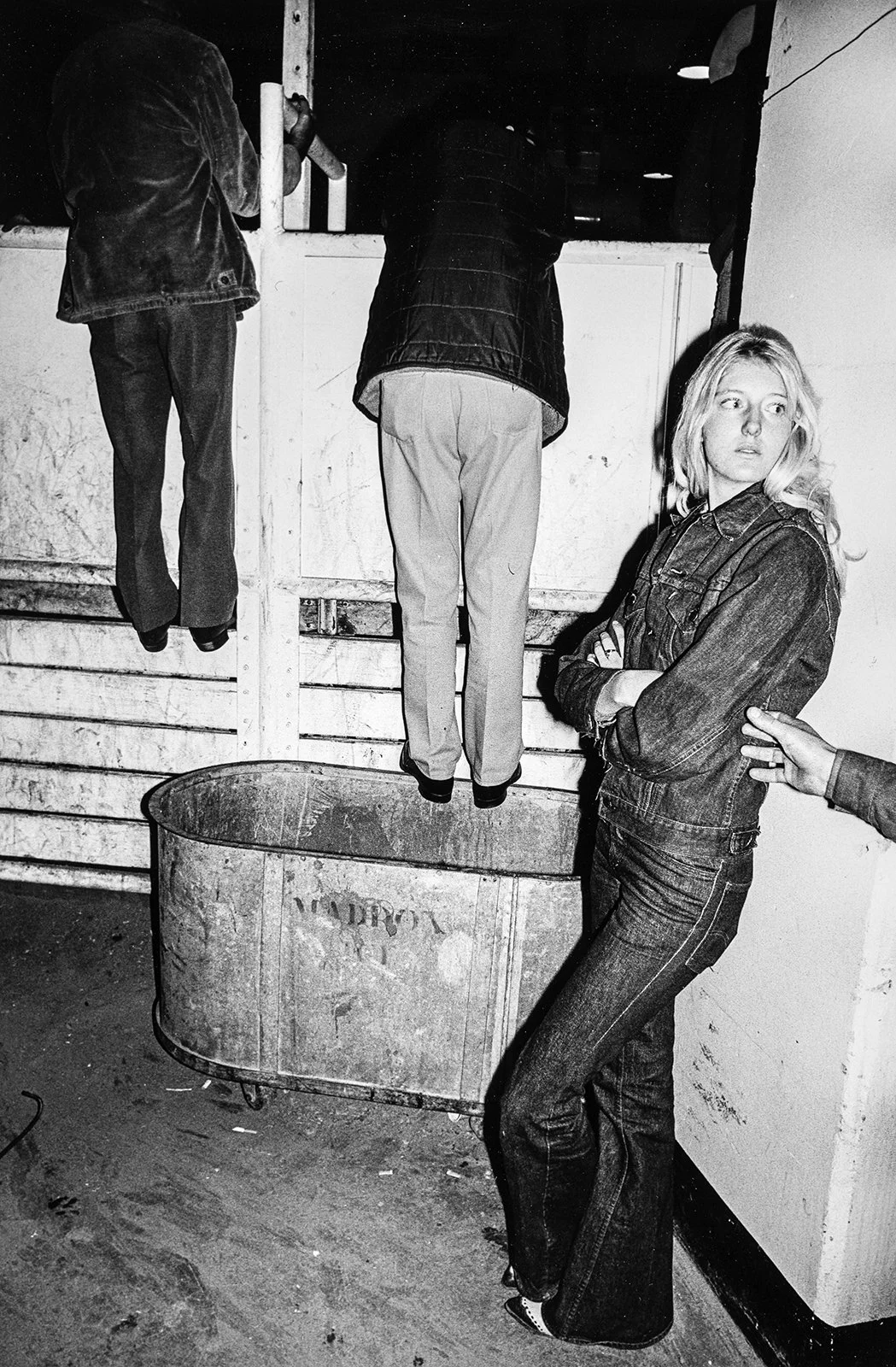
Back in December 2023 I posted an obituary and interview with the late Sandy Hume (born Richard Paul Hume, 1946-2023. LINK HERE). At the time I recognized Hume as being one of Colorado’s most important photography curators of the 1970s and 80s; what I failed to do was to acknowledge the breadth of his artistic work, which I have been studying for the past year courtesy of his daughter, Marcie, who has given me full access to his archive. That access has enabled me to recognize several biographical mistakes in my 2023 post. Most glaringly, I stated that Hume’s MFA thesis project revolved around his Stock Show imagery, which was published as Western Man in 1980. (1) In fact, his thesis was completed five years earlier, in 1975. Its title Aspects of Street Photography promises a treatise on social landscape photographers such as his mentors Gary Metz, Nathan Lyons and Garry Winogrand, but instead comprises a short statement that avoids any direct reference to his subject or influences thereon. A listing of ten untitled and undated 8 x 10 photographs, with no description of content, completes this disappointing document.
I first connected with Marcie a year or so ago when we met at her father’s former home. At the time I needed her permission to publish an image from Western Man. I arrived expecting to find an orderly collection of a few dozen prints; what I found instead were literally hundreds of prints scattered haphazardly throughout the two floors and basement darkroom of his cluttered home. Among the prints I found were numerous gelatin silver and some Type C color prints made primarily in Boulder and Denver, but also in NYC, Cape Cod, England, Paris, and elsewhere, whose content ranged from nature abstractions to city street documents, images from Western Man taken at the National Western Stock Show in Denver and in mining regions for a project titled From This Land (2), and photographs of friends and colleagues made at home and on trips to conferences.
Below L-R: Sandy Hume and Gary Metz; Barbara Houghton, Karen ?; Gary Metz; Alex Sweetman, unidentified.


Hume’s career in photography was short, little more than a decade, but evidence suggests that both as a curator and artist he was a tireless advocate of his own and others’ photography. In some of his earliest images (below) Hume played with shadow portraits made of himself in Colorado’s bright sunlight, and with geometric architectural forms and reflections. Beyond the images I found masses of photographic paper, contact sheets, 35mm negatives and slide transparencies, and - much like his mentor Garry Winogrand - plastic containers overflowing with exposed but undeveloped 35 mm and 120 mm film. In the past twelve months these have all been distributed to various schools and artists like Carol Golemboski, who uses outdated photo paper in her practice. (Golemboski will be the subject of my next post.) Web searches and inquiries from several institutions researching Hume and other Colorado photographers have revealed his work to be in permanent collections at MoMA, the Smithsonian Museum of Art, the Getty Museum, History Colorado, the Denver Art Museum, CU Boulder’s Norlin Library, and the Boulder Carnegie Library. His CV lists many more, as yet uncorroborated, collections, plus two NEA Fellowships (1976-1978). Situated between those is a 1977 Guggenheim Fellowship, which was awarded for a project he called "Anachronisms: A Geopolitical Survey."


Much of the early, early to mid-1970s imagery I found in Hume’s archive would fit the “Anachronisms” theme, but identifying specific prints made for the award is difficult. Unfortunately, most of his non-Stock Show prints are unsigned and undated, and very few of the titles that are given extend beyond “Untitled.” However, in the Acknowledgements chapter of his Western Man book, Hume notes that “photographs in this volume were directly supported by fellowships from the National Endowment for the Arts and the John Simon Guggenheim Memorial Foundation, which does open up the possibility that he concentrated his post-award efforts on Stock Show-related imagery. (3) Beyond a CV and some random notes, the only document I’ve found that directly references his prints is a receipt from MoMA’s Peter Galassi acknowledging receipt of three boxes containing 160 prints left for “Viewing” in August 1981.
In 1978, Galassi’s boss at the time, John Szarkowski, published one of Hume’s images in his seminal Mirrors and Windows: American Photography Since 1960 book and traveling exhibition. (4) The image (below), which I call “#28” but is listed in the book as “Untitled (1974),” is one of four prints in the MoMA permanent collection, which implies that the 160 deposited there in 1981 were a follow up donation that seems not to have been accepted. #28 is one of many images of players, spectators, and - to a slightly unsettling degree at high school locations - cheerleaders. Like another similar image (let’s call it “#24”) it was most likely taken at the CU Boulder football stadium. As with much of his MFA-era imagery (1973-75), both were made in daylight using flash, which freezes movement creates a startling coherence out of random energy; whereas any subliminal message in #28 is ambiguous, the plaster cast and sense of exhaustion in #24 is unique in its suggestion of the physical extremes and punishment endured by college football players.

Sandy Hume: Untitled (1974)

Sandy Hume: Untitled (ca. 1974)
Like #24 and #28, Hume’s abstract images rely on a combination of flash and long exposure that place him in the sphere of many other photographers working in the 1970s, among them Michael Bishop, Mark Cohen, and Roger Mertin, who he would include in his 1978 project From This Land (below). In 1977, his work was included with Bishop, Cohen, and Mertin in an exhibition titled “Flash” at the Miami-Dade Community College. (5) In his catalog statement he describes himself as “welcoming the span of possibility associated with the assimilation in one exposure of available light and flash illumination. With lengthy available light exposures,” he continues, “pictures drift into different stages of clarity with forms appearing sharply delineated and softly modulated simultaneously.”


Other images made during winter snow storms replicate the British photographer Martin Parr’s approach to “Bad Weather” - the title of Parr’s first book, published in 1982. For Parr, bad weather equates with rain and wind against which pedestrians huddle and strain, yet endure and cope - even enjoy. In contrast, Hume’s bad weather imagery (above) is devoid of hope or enjoyment - in fact it is devoid of humanity and conveys little except cold and emptiness. Hume visited the UK and France in the mid-1970s, when Parr was actively developing his early monochromatic documentary series of people and places in the UK, and the two intersected in their shared fascination with English people going about their routines, riding trains in stoic silence or communing with pigeons in Trafalgar Square.
Images below: Top Row: England, ca. 1974; Bottom Row: England, Ca. 1974; Man at Fairground, 1976 (CU Boulder collection); Cheerleaders, 1975 (Smithsonian collection); Woman in New York, 1974 (MoMA collection).


What some have dismissed as “flash and jiggle” gimmickry was only one aspect of Hume’s approach. In the set of hard-edged images below, the unifying strategy is obviously linguistic. Hume’s preference to edit within the frame creates wordplay whereby “Rant” is shortened from “Restaurant,” “Ices” perhaps from “Services,” and “Inks/Sters” from - well, your guess is a good as mine. A phrase such as “Me Too” carries a completely new relevance in the fifty years since it was taken, while “Swinger” - to my boomer generation at least - still conjures John Updike-like images of house keys in a party bowl.


From This Land: Survey of Mining in Colorado (1977-78, below) was his final collaborative project and his second curatorial effort, after The Great West: Real/Ideal, to be funded by the NEA. He organized it with Barbara Houghton while she was teaching at Metro State in Denver and he was teaching on the same campus at UC Denver. Sadly there was no book. Hume and Houghton both contributed images to the project (Hume’s in medium format B&W, Houghton’s in 4 x 5 in. B&W and 35 mm color). Other photographers included Robert Adams, Richard van Pelt, Linda Connor, Roger Mertin, and Ron Wohlauer.
Gallery below, L-R: Top row: Roger Mertin, Linda Connor, Barbara Houghton; Bottom Row: all photos by Sandy Hume.


Hume began his documentation of the National Western Stock Show while he was leading a double life as a Republican intern in Denver during the day, and a student in Boulder at night. In our 2017 interview, he described beginning his visits to the Stock Show as early as 1970 or 1971, but it seems more likely that he began the project during his graduate studies (1973-75) and thereafter while he was teaching at CU Boulder and later at UC Denver (the book was published in 1980, shortly after he concluded From This Land). (6)
While much of the Western Man imagery is candid, is posed B&W portraits are particularly strong, and it’s puzzling that so few of them are included in the book. Writing of his subjects in his book introduction, Hume explains that, “I have never found people more open to, and unafraid of, the idea of being photographed. The response to my photographic activity is usually a good natured “What-the-hell-are-you-doing-boy-with-all-these-crazy-pictures-and-who-you-work-for-anyway?” His agreement (unspoken it seems) was to give a 16 x 20 print to each subject whenever he saw them at the following years’ events. His proposition that they will show up in “antique shops of the prairie in a generation or so” is an intriguing one to investigate.
The sharp and stylish western clothing worn by many of his subjects lends a timeless quality to his portraits. Not surprisingly, hats are a defining factor, with the cowboys wearing wide-brimmed Stetsons, and businessmen wearing a more compact style leaning toward a fedora, and the ranch hands and vendors more likely to be equipped with farmer’s hats bearing logos. My understanding is that aside from the hand-stitched quality that defines the immediate post-WWII era, western wear hasn’t dramatically changed in the fifty years since Hume’s portraits were made, so to my untutored eye it the farmer’s hats that most convey a sense of passing time. The gallery below shows several of the posed portraits, including two scans of 5 x 7 in. work prints that identify their subjects. I’ve included them here alongside their equivalent “final” versions that were printed on fiber paper.


Looking through his complete archive, it is obvious that the book’s print quality and choice of images, which he ascribes gratefully to Reed Estabrook of the University of Northern Iowa, fail to do justice to the western document as a whole. Throughout his Stock Show image-making, Hume continued to use flash and photograph in candid situations, capturing people front and backstage aspects of the event, as well as the outdoor pens, rodeos, and social events. It’s possible some of the imagery in the book was made at State Fairs, local rodeos, and the like, which recur as locations throughout the archive. While his B&W imagery is by far his strongest, his color images of of bull and bronco riding are notable for the combustible energy emanating through his use of flash and long exposure.
Sandy Hume gave up photography for politics in 1982, serving as a Republican in the State House and Senate, and eventually as State Treasurer before leaving that profession for real estate. (6) Since meeting with Marcie at his house I have spent many long hours sorting through his archive and following his numbering system in an effort to understand the chronology of his production. Unfortunately, while he was careful to match contact sheet numbers with prints and negative sheets he rarely actually dated his prints, and tended to adopt a “two steps forward one step back approach” to his numbering.
It has been fascinating to begin to understand his vision, however, and to begin to discern his approach and the details that attracted him. Much of his work - Bad Weather in particular, or night flash projects, seem random and it is likely he triggered the shutter as his mentor Winogrand did - to see what the thing he photographed looked like as an image. As his collection takes shape so does his career trajectory, his process, and the exhaustive commitment he made to his medium during his brief fifteen years or so career in Colorado.
LINK TO SANDY HUME INTERVIEW AND OBITUARY HERE
(1) Sandy Hume, Western Man: Photographs of the National Western Stock Show (Boulder: Johnson Pub. Co., 1980). Essay by Max Kozloff. Western Man was exhibited at the University of Northern Iowa after his thesis exhibition.
(2) From This Land: Survey of Mining in Colorado. The project archive is accessible at History Colorado in Denver.
(3) Compounding problems with identifying and dating works, Hume did mention losing a lot of paperwork in a flood when we spoke in June 2017.
(4) John Szarkowski, Mirrors and Windows: American Photography Since 1960 (New York: Museum of Modern Art, 1978), 24. Hume’s image is attributed to Richard P. Hume.
(5) Flash was presented at the Miami-Dade Community College, South Campus Gallery, October 3-20, 1977. Catalog introduction by Dave Read. Hume’s work was previously accompanied by Bishop, Cohen, and Mertin in Peculiar to Photography, an exhibition at the University of New Mexico Art Museum in 1976. Other photographers were Michael Becotte, Harry Callahan, Paul Diamond, Lee Friedlander, John Gossage, Gary Hallman, Anthony Hernandez, Richard Neal, Anne Noggle, Richard Reep, Roberto Salbitani, Richard Schaeffer, and Garry Winogrand. In their preface, Van Deren Coke and Thomas Barrow write that “stroboscopic Illumination” creates distortions by which “commonplace things take on unexpected relationships and connotations as tones merge, forms overlap and horizons are tilted or seem to wrap around a subject.” Hume’s work is credited to Richard P. Hume.
(6) Western Man was exhibited at the University of Northern Iowa (UNI) in conjunction with the book’s release, which was distributed by CU Boulder and UNI. In our June 2017 interview, Hume credits UNI instructor Reed Estabrook with organizing the show and helping to sell books.
(7) Hume won election as State Representative for District 13 (Boulder) in 1982. He was elected to the State Senate representing District 17 in 1988. According to state records, he last won election to District 17 in 2004.