Stock Show

Carlos Fresquez interview

Carlos Fresquez is a Chicano painter, media artist, and celebrated educator. He was born in Denver’s Fitzsimmons Army Hospital in 1956. After graduating from Lincoln High School he earned a BA in 1980  at Metro State University (then Community College) and an MFA at CU Boulder (1995). After graduating from CU, he began a three-decade tenure teaching in the Metro State art department (1990-2024). Since his retirement, he has continued making art at his home in SW Denver while producing occasional offsite projects such as murals.

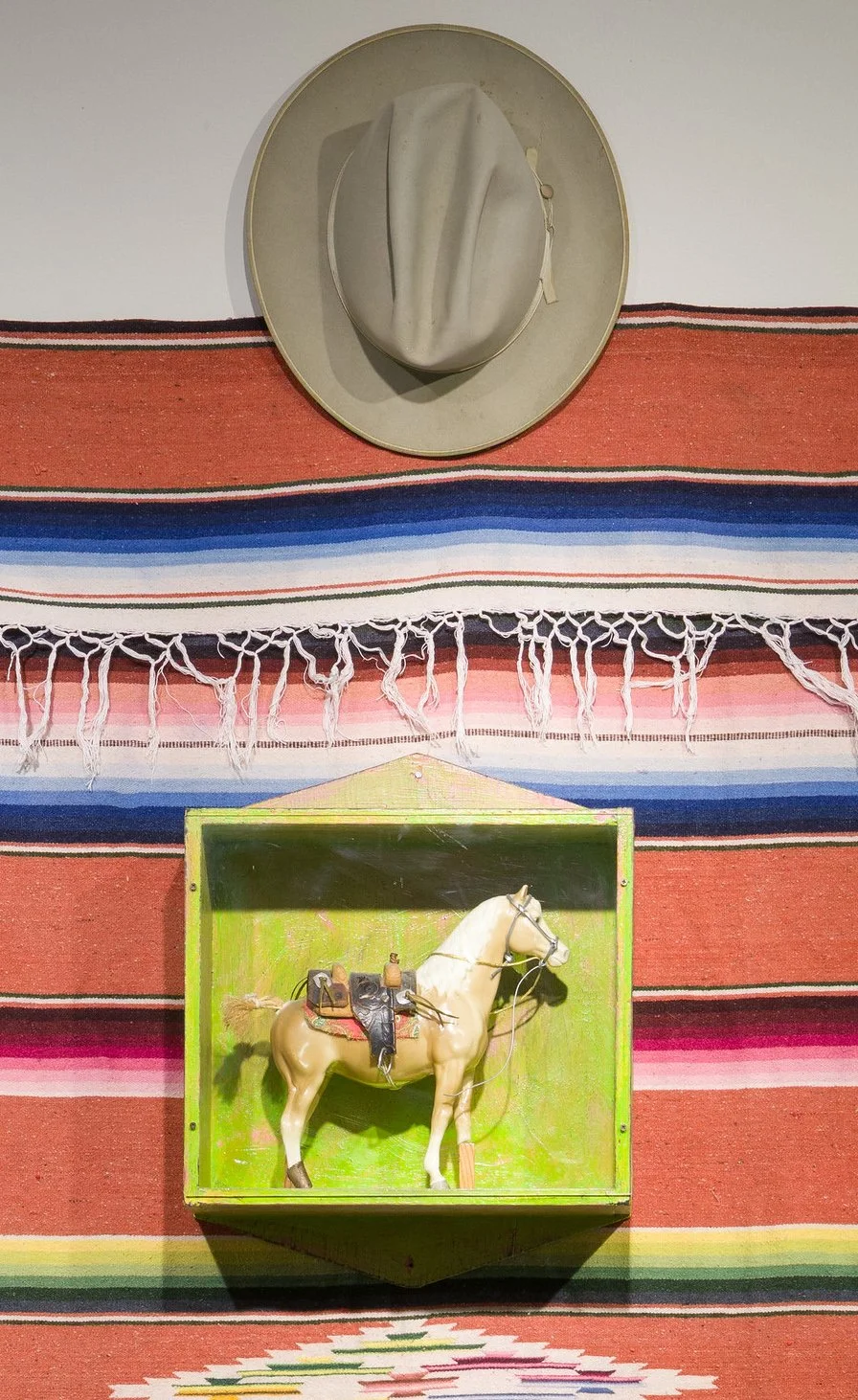
At the Arvada Center this fall, 2026, I viewed Alter Para Mi Abuelo, Fernando Fresquez (above), an alter made by Carlos to honor his grandfather, Fernando Fresquez. I immediately recognized that for many of the reasons we discuss below, it would fit perfectly into a show I’m curating to open next January in Denver in the Legacy Building galleries at the National Western Center. Titled Leave Your Hat On, the show also includes photographs by Sandy Hume and Gabriela Hasbun, and watercolors by Monique Crine.

Carlos has exhibited his drawings, prints, installations and paintings in over thirty US venues and in more than a dozen countries. In Denver in 2018, the Center for Visual Art hosted Carlos Frésquez: Sangre Colorado, a retrospective that critic Michael Paglia described as “a gloriously over-the-top survey.” Recent exhibition venues include the Emmanuel Gallery, Arvada Center, and currently MCA Denver. In March 2027, a solo show of work by Carlos will open at the Kirkland Museum in Denver.

I spoke with Carlos at his home in southwest Denver late July 2026.


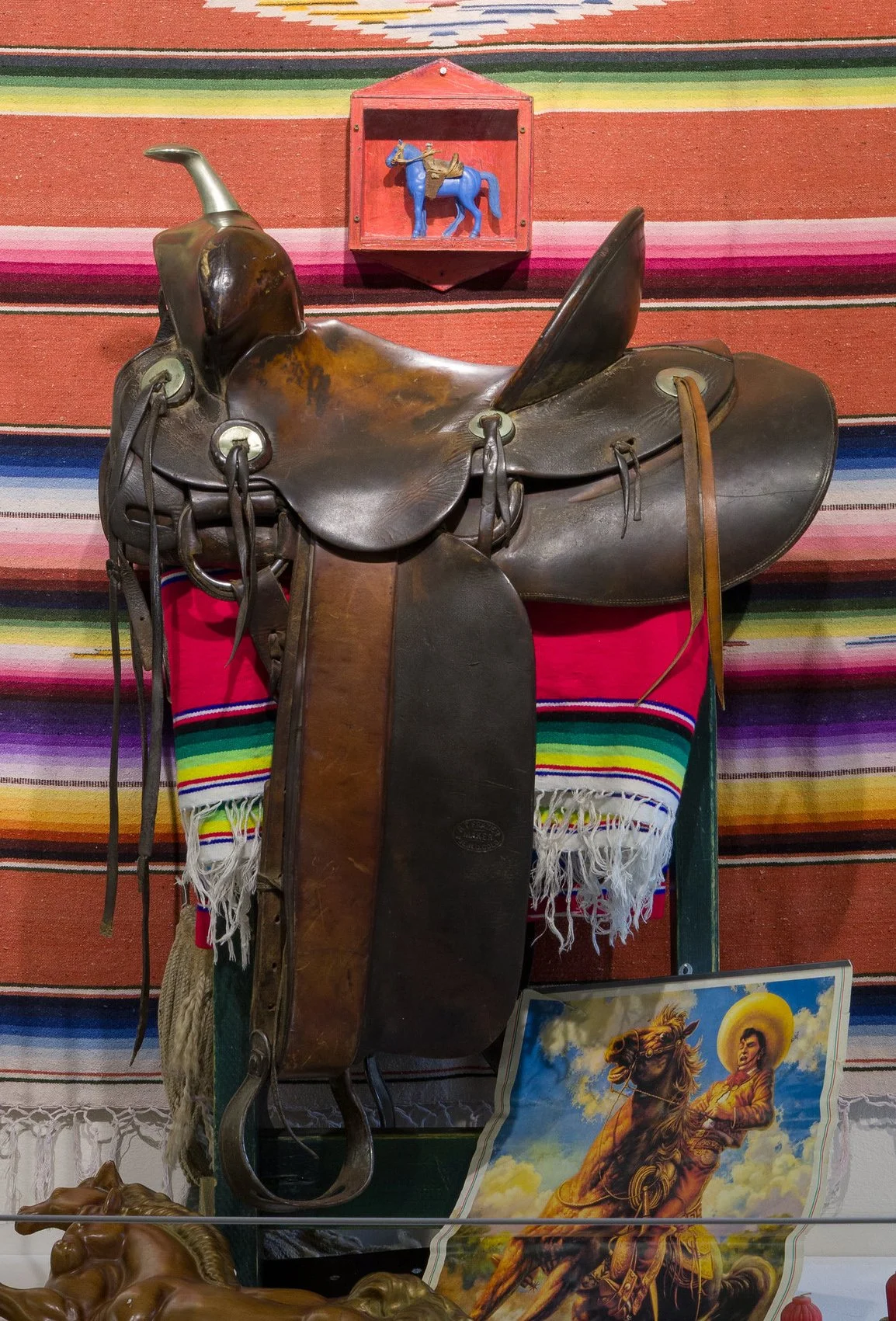
Carlos Fresquez: Alter Para Mi Abuelo, Fernando Fresquez. Mixed media with my grandfather’s 1930 saddle, 1998/2026. Fresquez Family Collection.

Rupert Jenkins:      Among other things, your alter includes photographs, hand-crafted objects, a vintage saddle and a hat, all offset by a vividly-colored sarape. Is that the kind of thing your grandfather would've worn as a ranch hand a hundred years ago?

Carlos Fresquez:       No, it wouldn't be anything as nice. My grandfather herded cattle from Northern New Mexico and Southern Colorado and back and forth for different ranch owners. They probably had a pack on the back of the horse, a sleeping bag of some sorts, and then of course, gear and clothing set for whatever weather they had to contend with. And so I'm assuming if it was winter he'd really be dressed up warm and in the summer or rain, he’d be prepared for all that.

RJ:      He was an itinerant vaquero?

CF:       I guess he was hired by ranch owners to work for them, to move the cattle from one place to the other, to different grazing locations. So, as my grandmother told me, he'd be gone for several weeks to months even, just either taking them to sell or to graze.

RCJ:      Where was his home?

CF:       At the time [1920s until the early 1950s] they lived in Southern Colorado in Del Norte, Colorado, South Fork, Colorado, all in that area, depending on the ranch that would hire him.

Left: At Paulson Ranch west of Del Norte. Summer of 1949. Note: Riding Rosie is Ricardo Fresquez (left), youngest brother of Fernando Fresquez who is riding Esther. Fernando was working for The Cattlemens Assoc. and stayed in cabin at Embargo Creek area from May thru September. Right: Marriage of Fernando Fresquez (at left) and Lorencita Quintana, August 1920. Note: First child born April 25, 1927 Maclovia (Maggie) Fresquez, now Archuleta. Second child born Oct. 29, 1933. Carlo Fresquez (Near Southfork, CO) (actual birthplace Bear Creek).

RJ:        Do you have strong recollections of Fernando?

CF:        My grandfather, he was such a stoic man and he was tall. He was probably a little over six feet. And then with his hat, he always looked taller. By the time he was in his seventies, he was still working on ranches with his brother in Southern Colorado and around Del Norte, South Fork, because I think that's where his brother lived—he'd go help him chop wood and herd the cattle or whatever needed doing. But I just remember him as always so kind. His first language was Spanish, born and raised in Las Vegas, New Mexico. Definitely a US citizen, right? From families that go back centuries. His parents were probably actually in Mexico at the time before the border crossed over in 1848 [the Guadalupe-Hidalgo Treaty, when Mexico ceded vast tracts of Southwestern land to the US.]

RCJ:      You’ve placed photographs on either side of the alter. Can you talk about those?

CF:       Yeah. I was told some photographer came through documenting the West – back in the 1920s, I guess. I have the original photographs but I didn't want to use them [for the alter]. I just printed these in a sepia photocopy so I could mount them onto board. And then I kind of scratched them up to give them a little vintage look.

[Looking at the wedding photo] This is my grandfather, the tall figure on the left, and my grandmother. And then these [on the right] are the people that witnessed. I'm not sure where they got married. They were from New Mexico. My grandfather was from Las Vegas, New Mexico, and my grandmother was from Pecos, New Mexico.

RCJ:      And they just happened to get married when the photographer was there?

CF:       I don't know. They might have hired a photographer to take the wedding picture or just someone with a camera took the picture. I don't know.

RCJ:      So it's not necessarily the same photographer for all these pictures.

CF:       Exactly. Exactly.
RCJ:      In the center of the alter you’ve placed two small horses in boxes.

CF:       Those are the toys I had as a kid. When I was a child, maybe eight, nine years old, my grandfather went to the thrift store and found these toy horses. And then he actually got a belt and cut the leather and made a saddle. For the stirrup, I guess, he used the pop tab from an old can. I made the boxes to keep them up. They collect so much dust and I just wanted to honor them and not lose them.

RCJ:      And the real saddle is his original saddle?

CF:       The saddle is his working saddle from 1930. There's a stamp on there and I think it says it's made in Pueblo.

RCJ:      It's in beautiful condition.

CF:       Yeah, I always thought I should protect it. It was his working saddle and on the back of it he put his initials, “FF,” Fernando Fresca. At the base [of the alter] is an old calendar I found in Mexico on my travels. The last piece, I guess, is a plaster cast of two horses. My grandmother and grandfather had that hanging on the wall in their home. And on the back he actually put a brand, two Fs. One F's facing this way and the other's inverted going the other way. So he made his own brand.

RCJ:      Nice. And the hat?

CF:       That's his original hat. He didn't wear this actual one when he was herding cattle [but] he always wore a hat. When he died in 1974, I asked if there's any stuff I could have of his. And my parents said, "Oh yeah, here's this hat." Luckily they had it in a hat box, so it's been saved since 1974. Fifty years.

Left: Picture taken on Falk Bro. ranch, west of Del Norte, CO. June or July 1949. Back to camera: Fernando Fresquez, age 49. Carlo Fresquez, age 15, holding reins (horse is Rosie). Born Oct. 29, 1933. Right: Branding calves in Tercio, CO. Spring of 1929. Fernando Fresquez, born May 30, 1900, age 28 or 29, in checkered shirt.


RCJ:      You've shown this alter piece a lot. When did you first make it?

CF:       I initially created it probably thirty years ago. I think it was for the Children's Hospital. I had a little placard to the right of the installation, and I found little notes tucked in it. People would be like, "Oh, my grandfather was a cowboy and he herded cattle and I love this story." I just found that really interesting that people would want to comment and share their story.

I’ve always liked adding this [storytelling] element to it because a lot of cowboys were Mexicans and African Americans and the people that owned the ranches were usually white. They had their children help on the farmer ranch as well, but then the hired hands would be the lower class. So it's typically the Blacks and the Mexican Americans that were the workers.

A lot of English cowboy words are very similar in Spanish. Lasso in the Spanish is very much the same. Arena is sand; and that's where they would hold competitions, in the arena or the sand. Even the dances and the clothing – you look at square dancing and the clothing that the Mexicans would wear and the way they would dance, they [white cowboys] just took pretty much everything from the Mexican cowboy. So when I've heard derogatory comments from racist cowboys to Mexican Americans, it's like, "Well, you're carrying this history from the Mexican and you don't even realize it.” So that's why, when I put this installation together, I thought I definitely need to show a word chart with it (below).


RCJ:      How do you identify as an artist, ethnically? Chicano, or Mexican American, Latino?

I'll take any, whatever. Actually my genealogy goes back to the first settlements in Santa Fe, when the Spanish Viceroy in Mexico City sent two brothers from Flanders to New Mexico to look for minerals. The Native people had the Pueblo Revolt and chased them back to either El Paso, Juarez, or even further down to Chihuahua. Twenty years later, one of the brothers stayed down there and the other one came back up into Santa Fe, and that was my lineage. That was in the 1600s.

Our DNA group shows that we're also Native – I have 50% Indigenous ancestry from the Pueblo people in Albuquerque, Santa Fe, and then the European part, But I consider myself a Chicano artist because I came out of that time period where I attended my first protest at thirteen-years-old. One of my friends, Sidney Martinez, his dad was part of the Crusade for Justice here in Denver. And so he asked me, "Do you want to go to the Crusade for Justice?" Well, what's that? And here I'm thirteen. There's all this racism in school, which I experienced, and he goes, "This is to fight that. They're looking for justice for all people." So I started attending these meetings and helping make protest banners and stuff until probably high school. So that really affected me as a kid.

RCJ:      Were you making art then?

CF:       I've always just wanted to do this, be an artist. When I started in high school preparing for college I would just focus on drawing and painting, mostly painting. Lincoln High School had really good art program back then – they had all the disciplines, jewelry, ceramics, metal, wood shop, plastic, mold and bent, plastic, sculpture class. I mean, you name it, you could do it back then.

I started getting very Latino focused, or Chicano focused, on my artwork that I created in high school. Here in Denver, when I heard Corky Gonzalez from the Crusade of Justice say things like, "We're told that we're lazy as Mexicans, we're worthless, we're dirty, blah, blah, blah, and call these derogatory names, we are not that. We come from great civilizations and so on and so forth," I started creating these little Aztec deities or Indigenous forms – those are the kind of things I was looking at to be empowered. And then when I got to college, I just focused on pretty much on painting.

RCJ:      Who was your teacher in college?

CF:       His name was Bill Hayes, Charles William Hayes. He went by Bill Hayes. And he was a color field painter, completely the opposite of me. He was painting with squeegees. His color was very much like Monet, but it was all translucent. He'd do like sixty layers - it looked like waves of water almost. He was very supportive. [At first] the drawing teacher, Jean Schiff, was so harsh and cruel with her critiques. My first day of class, it was just like, God, I can't handle this woman. And after I worked with her probably three or four semesters, she just took me under her wing and said, “You are amazing. You can do this.” She just really pushed and guided me and prepared me to be a practicing and surviving artist. And so she became almost a second mother in a way.

RCJ:      Would you think of her as a mentor then?

CF:       Yeah. Yeah, definitely. Definitely. She taught me all these techniques and I would just stay after class if I could, or if there was no other class afterwards. And then I'd go in on weekends and on my own time and just live there. I lived on campus for a long time.

RCJ:      You’ve talked about Bill Hayes and Jean Schiff as mentors who helped develop your artmaking and career. Several people have told me that you yourself have been a really influential teacher at Metro and you've mentored a lot of young artists.

CF: Yeah. I’m really humbled by that actually because my intent was never to be a teacher. I graduated [from Metro] in 1980 and ten years later, Bill called me up and he said, "Carlos, I have to have back surgery. I want you to substitute for ten weeks and then I'll come back the remaining six and I'll finish up the class." I'm on the old cord phone and I'm like, "No, I really don't want to teach. I don't want to do this, Bill." And my wife's telling me, "Just do it, Carlos. It's ten weeks. What are you worried about? You just exhibited in the Bronx Museum, the Smithsonian, California. You have this experience. Just share that, do it.” So I go to my class, I give the syllabus, talk to them. Okay, that was easy. Day one. Day two, they're actually starting to work. And before I knew it, the ten weeks were over.

Well, I got a call before the next semester and the department chair said, "Carlos, the students that you taught wrote me a letter and said we should hire you as a teacher. I'm going to set you up for a drawing class next semester." So I said, "Okay, just one class." So then I taught that one class and that's when everything just started meshing. And yeah, I met students that still hit me up to this day. I'll be shopping in Meininger's and they'll give me a hug and say, "God, Carlos, you're just an amazing teacher." And all I know is, I was just honest and truthful and there for the students. So it's nice to get that feedback and that you heard it as well.

RCJ: Definitely. Okay. Well, you've given me an awful lot of information and material, so let's call it a day for now and we’ll talk again soon.

END


All images scanned from original photographs; courtesy of Carlos Fresquez. To view Carlos’s work visit carlosfresquez.com. Leave Your Hat On opens with the annual Stock Show art exhibition in the Legacy Building galleries, National Western Center, January 2027.


Sandy Hume Part Two: Photographs & Exhibitions

Back in December 2023 I posted an obituary and interview with the late Sandy Hume (born Richard Paul Hume, 1946-2023. LINK HERE). At the time I recognized Hume as being one of Colorado’s most important photography curators of the 1970s and 80s; what I failed to do was to acknowledge the breadth of his artistic work, which I have been studying for the past year courtesy of his daughter, Marcie, who has given me full access to his archive. That access has enabled me to recognize several biographical mistakes in my 2023 post. Most glaringly, I stated that Hume’s MFA thesis project revolved around his Stock Show imagery, which was published as Western Man in 1980. (1) In fact, his thesis was completed five years earlier, in 1975. Its title Aspects of Street Photography promises a treatise on social landscape photographers such as his mentors Gary Metz, Nathan Lyons and Garry Winogrand, but instead comprises a short statement that avoids any direct reference to his subject or influences thereon. A listing of ten untitled and undated 8 x 10 photographs, with no description of content, completes this disappointing document.

I first connected with Marcie a year or so ago when we met at her father’s former home. At the time I needed her permission to publish an image from Western Man. I arrived expecting to find an orderly collection of a few dozen prints; what I found instead were literally hundreds of prints scattered haphazardly throughout the two floors and basement darkroom of his cluttered home. Among the prints I found were numerous gelatin silver and some Type C color prints made primarily in Boulder and Denver, but also in NYC, Cape Cod, England, Paris, and elsewhere, whose content ranged from nature abstractions to city street documents, images from Western Man taken at the National Western Stock Show in Denver and in mining regions for a project titled From This Land (2), and photographs of friends and colleagues made at home and on trips to conferences.

Below L-R: Sandy Hume and Gary Metz; Barbara Houghton, Karen ?; Gary Metz; Alex Sweetman, unidentified.

Hume’s career in photography was short, little more than a decade, but evidence suggests that both as a curator and artist he was a tireless advocate of his own and others’ photography. In some of his earliest images (below) Hume played with shadow portraits made of himself in Colorado’s bright sunlight, and with geometric architectural forms and reflections. Beyond the images I found masses of photographic paper, contact sheets, 35mm negatives and slide transparencies, and - much like his mentor Garry Winogrand - plastic containers overflowing with exposed but undeveloped 35 mm and 120 mm film. In the past twelve months these have all been distributed to various schools and artists like Carol Golemboski, who uses outdated photo paper in her practice. (Golemboski will be the subject of my next post.) Web searches and inquiries from several institutions researching Hume and other Colorado photographers have revealed his work to be in permanent collections at MoMA, the Smithsonian Museum of Art, the Getty Museum, History Colorado, the Denver Art Museum, CU Boulder’s Norlin Library, and the Boulder Carnegie Library. His CV lists many more, as yet uncorroborated, collections, plus two NEA Fellowships (1976-1978). Situated between those is a 1977 Guggenheim Fellowship, which was awarded for a project he called "Anachronisms: A Geopolitical Survey."

Much of the early, early to mid-1970s imagery I found in Hume’s archive would fit the “Anachronisms” theme, but identifying specific prints made for the award is difficult. Unfortunately, most of his non-Stock Show prints are unsigned and undated, and very few of the titles that are given extend beyond “Untitled.” However, in the Acknowledgements chapter of his Western Man book, Hume notes that “photographs in this volume were directly supported by fellowships from the National Endowment for the Arts and the John Simon Guggenheim Memorial Foundation, which does open up the possibility that he concentrated his post-award efforts on Stock Show-related imagery. (3) Beyond a CV and some random notes, the only document I’ve found that directly references his prints is a receipt from MoMA’s Peter Galassi acknowledging receipt of three boxes containing 160 prints left for “Viewing” in August 1981.

In 1978, Galassi’s boss at the time, John Szarkowski, published one of Hume’s images in his seminal Mirrors and Windows: American Photography Since 1960 book and traveling exhibition. (4) The image (below), which I call “#28” but is listed in the book as “Untitled (1974),” is one of four prints in the MoMA permanent collection, which implies that the 160 deposited there in 1981 were a follow up donation that seems not to have been accepted. #28 is one of many images of players, spectators, and - to a slightly unsettling degree at high school locations - cheerleaders. Like another similar image (let’s call it “#24”) it was most likely taken at the CU Boulder football stadium. As with much of his MFA-era imagery (1973-75), both were made in daylight using flash, which freezes movement creates a startling coherence out of random energy; whereas any subliminal message in #28 is ambiguous, the plaster cast and sense of exhaustion in #24 is unique in its suggestion of the physical extremes and punishment endured by college football players.

Sandy Hume: Untitled (1974)

Sandy Hume: Untitled (ca. 1974)


Like #24 and #28, Hume’s abstract images rely on a combination of flash and long exposure that place him in the sphere of many other photographers working in the 1970s, among them Michael Bishop, Mark Cohen, and Roger Mertin, who he would include in his 1978 project From This Land (below). In 1977, his work was included with Bishop, Cohen, and Mertin in an exhibition titled “Flash” at the Miami-Dade Community College. (5) In his catalog statement he describes himself as “welcoming the span of possibility associated with the assimilation in one exposure of available light and flash illumination. With lengthy available light exposures,” he continues, “pictures drift into different stages of clarity with forms appearing sharply delineated and softly modulated simultaneously.”

Other images made during winter snow storms replicate the British photographer Martin Parr’s approach to “Bad Weather” - the title of Parr’s first book, published in 1982. For Parr, bad weather equates with rain and wind against which pedestrians huddle and strain, yet endure and cope - even enjoy. In contrast, Hume’s bad weather imagery (above) is devoid of hope or enjoyment - in fact it is devoid of humanity and conveys little except cold and emptiness. Hume visited the UK and France in the mid-1970s, when Parr was actively developing his early monochromatic documentary series of people and places in the UK, and the two intersected in their shared fascination with English people going about their routines, riding trains in stoic silence or communing with pigeons in Trafalgar Square.

Images below: Top Row: England, ca. 1974; Bottom Row: England, Ca. 1974; Man at Fairground, 1976 (CU Boulder collection); Cheerleaders, 1975 (Smithsonian collection); Woman in New York, 1974 (MoMA collection).

What some have dismissed as “flash and jiggle” gimmickry was only one aspect of Hume’s approach. In the set of hard-edged images below, the unifying strategy is obviously linguistic. Hume’s preference to edit within the frame creates wordplay whereby “Rant” is shortened from “Restaurant,” “Ices” perhaps from “Services,” and “Inks/Sters” from - well, your guess is a good as mine. A phrase such as “Me Too” carries a completely new relevance in the fifty years since it was taken, while “Swinger” - to my boomer generation at least - still conjures John Updike-like images of house keys in a party bowl.

From This Land: Survey of Mining in Colorado (1977-78, below) was his final collaborative project and his second curatorial effort, after The Great West: Real/Ideal, to be funded by the NEA. He organized it with Barbara Houghton while she was teaching at Metro State in Denver and he was teaching on the same campus at UC Denver. Sadly there was no book. Hume and Houghton both contributed images to the project (Hume’s in medium format B&W, Houghton’s in 4 x 5 in. B&W and 35 mm color). Other photographers included Robert Adams, Richard van Pelt, Linda Connor, Roger Mertin, and Ron Wohlauer.

Gallery below, L-R: Top row: Roger Mertin, Linda Connor, Barbara Houghton; Bottom Row: all photos by Sandy Hume.

Hume began his documentation of the National Western Stock Show while he was leading a double life as a Republican intern in Denver during the day, and a student in Boulder at night. In our 2017 interview, he described beginning his visits to the Stock Show as early as 1970 or 1971, but it seems more likely that he began the project during his graduate studies (1973-75) and thereafter while he was teaching at CU Boulder and later at UC Denver (the book was published in 1980, shortly after he concluded From This Land). (6)

While much of the Western Man imagery is candid, is posed B&W portraits are particularly strong, and it’s puzzling that so few of them are included in the book. Writing of his subjects in his book introduction, Hume explains that, “I have never found people more open to, and unafraid of, the idea of being photographed. The response to my photographic activity is usually a good natured “What-the-hell-are-you-doing-boy-with-all-these-crazy-pictures-and-who-you-work-for-anyway?” His agreement (unspoken it seems) was to give a 16 x 20 print to each subject whenever he saw them at the following years’ events. His proposition that they will show up in “antique shops of the prairie in a generation or so” is an intriguing one to investigate.

The sharp and stylish western clothing worn by many of his subjects lends a timeless quality to his portraits. Not surprisingly, hats are a defining factor, with the cowboys wearing wide-brimmed Stetsons, and businessmen wearing a more compact style leaning toward a fedora, and the ranch hands and vendors more likely to be equipped with farmer’s hats bearing logos. My understanding is that aside from the hand-stitched quality that defines the immediate post-WWII era, western wear hasn’t dramatically changed in the fifty years since Hume’s portraits were made, so to my untutored eye it the farmer’s hats that most convey a sense of passing time. The gallery below shows several of the posed portraits, including two scans of 5 x 7 in. work prints that identify their subjects. I’ve included them here alongside their equivalent “final” versions that were printed on fiber paper.

Looking through his complete archive, it is obvious that the book’s print quality and choice of images, which he ascribes gratefully to Reed Estabrook of the University of Northern Iowa, fail to do justice to the western document as a whole. Throughout his Stock Show image-making, Hume continued to use flash and photograph in candid situations, capturing people front and backstage aspects of the event, as well as the outdoor pens, rodeos, and social events. It’s possible some of the imagery in the book was made at State Fairs, local rodeos, and the like, which recur as locations throughout the archive. While his B&W imagery is by far his strongest, his color images of of bull and bronco riding are notable for the combustible energy emanating through his use of flash and long exposure.

Sandy Hume gave up photography for politics in 1982, serving as a Republican in the State House and Senate, and eventually as State Treasurer before leaving that profession for real estate. (6) Since meeting with Marcie at his house I have spent many long hours sorting through his archive and following his numbering system in an effort to understand the chronology of his production. Unfortunately, while he was careful to match contact sheet numbers with prints and negative sheets he rarely actually dated his prints, and tended to adopt a “two steps forward one step back approach” to his numbering.

It has been fascinating to begin to understand his vision, however, and to begin to discern his approach and the details that attracted him. Much of his work - Bad Weather in particular, or night flash projects, seem random and it is likely he triggered the shutter as his mentor Winogrand did - to see what the thing he photographed looked like as an image. As his collection takes shape so does his career trajectory, his process, and the exhaustive commitment he made to his medium during his brief fifteen years or so career in Colorado.


LINK TO SANDY HUME INTERVIEW AND OBITUARY HERE

(1) Sandy Hume, Western Man: Photographs of the National Western Stock Show (Boulder: Johnson Pub. Co., 1980). Essay by Max Kozloff. Western Man was exhibited at the University of Northern Iowa after his thesis exhibition.

(2) From This Land: Survey of Mining in Colorado. The project archive is accessible at History Colorado in Denver.

(3) Compounding problems with identifying and dating works, Hume did mention losing a lot of paperwork in a flood when we spoke in June 2017.

(4) John Szarkowski, Mirrors and Windows: American Photography Since 1960 (New York: Museum of Modern Art, 1978), 24. Hume’s image is attributed to Richard P. Hume.

(5) Flash was presented at the Miami-Dade Community College, South Campus Gallery, October 3-20, 1977. Catalog introduction by Dave Read. Hume’s work was previously accompanied by Bishop, Cohen, and Mertin in Peculiar to Photography, an exhibition at the University of New Mexico Art Museum in 1976. Other photographers were Michael Becotte, Harry Callahan, Paul Diamond, Lee Friedlander, John Gossage, Gary Hallman, Anthony Hernandez, Richard Neal, Anne Noggle, Richard Reep, Roberto Salbitani, Richard Schaeffer, and Garry Winogrand. In their preface, Van Deren Coke and Thomas Barrow write that “stroboscopic Illumination” creates distortions by which “commonplace things take on unexpected relationships and connotations as tones merge, forms overlap and horizons are tilted or seem to wrap around a subject.” Hume’s work is credited to Richard P. Hume.

(6) Western Man was exhibited at the University of Northern Iowa (UNI) in conjunction with the book’s release, which was distributed by CU Boulder and UNI. In our June 2017 interview, Hume credits UNI instructor Reed Estabrook with organizing the show and helping to sell books.

(7) Hume won election as State Representative for District 13 (Boulder) in 1982. He was elected to the State Senate representing District 17 in 1988. According to state records, he last won election to District 17 in 2004.